Felix Schwarz · 9 September 2026
How Server Response Variations Shape Crawl Frequency Patterns During Large-Scale Content Refreshes
Server responses form the first point of contact between websites and automated crawlers, and variations in those responses directly influence how often bots return to specific pages, particularly when organizations push through major content refreshes across thousands of URLs. Research indicates that status codes, latency measurements, and header configurations send signals that search engine systems interpret as indicators of site health and update priority, which in turn adjusts crawl budgets allocated to each domain.
Core Mechanisms Behind Response Signals
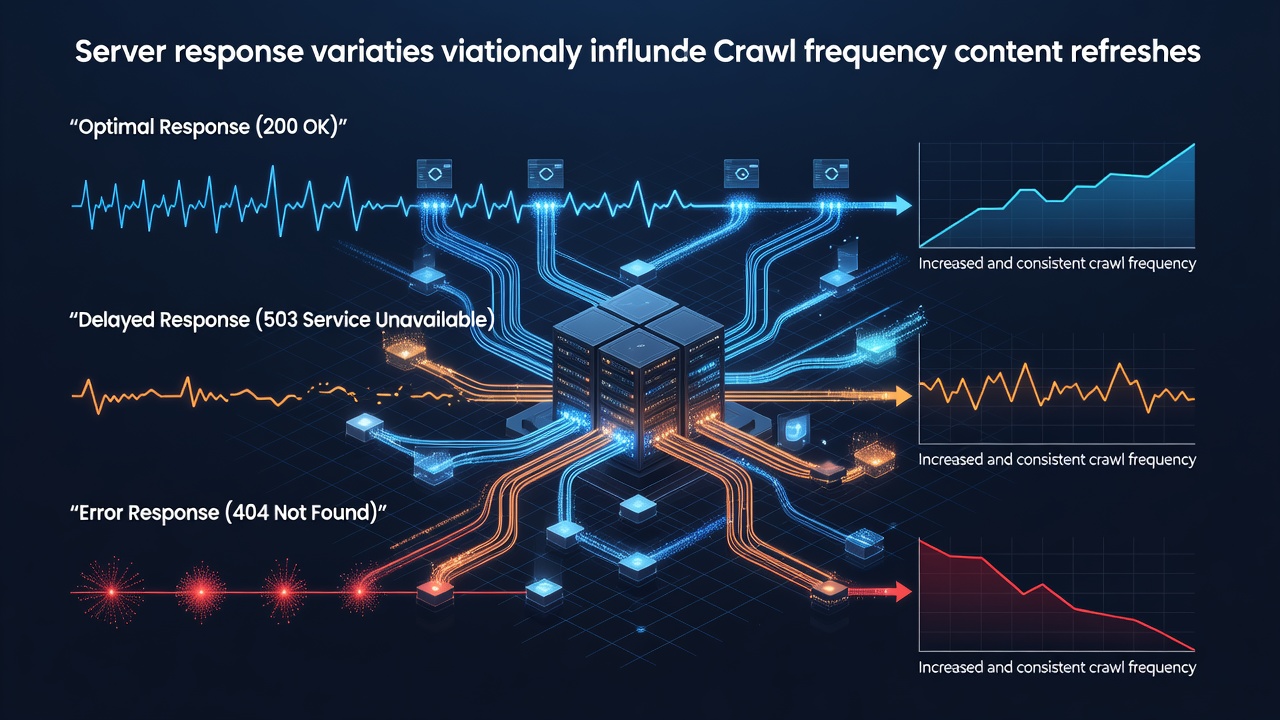
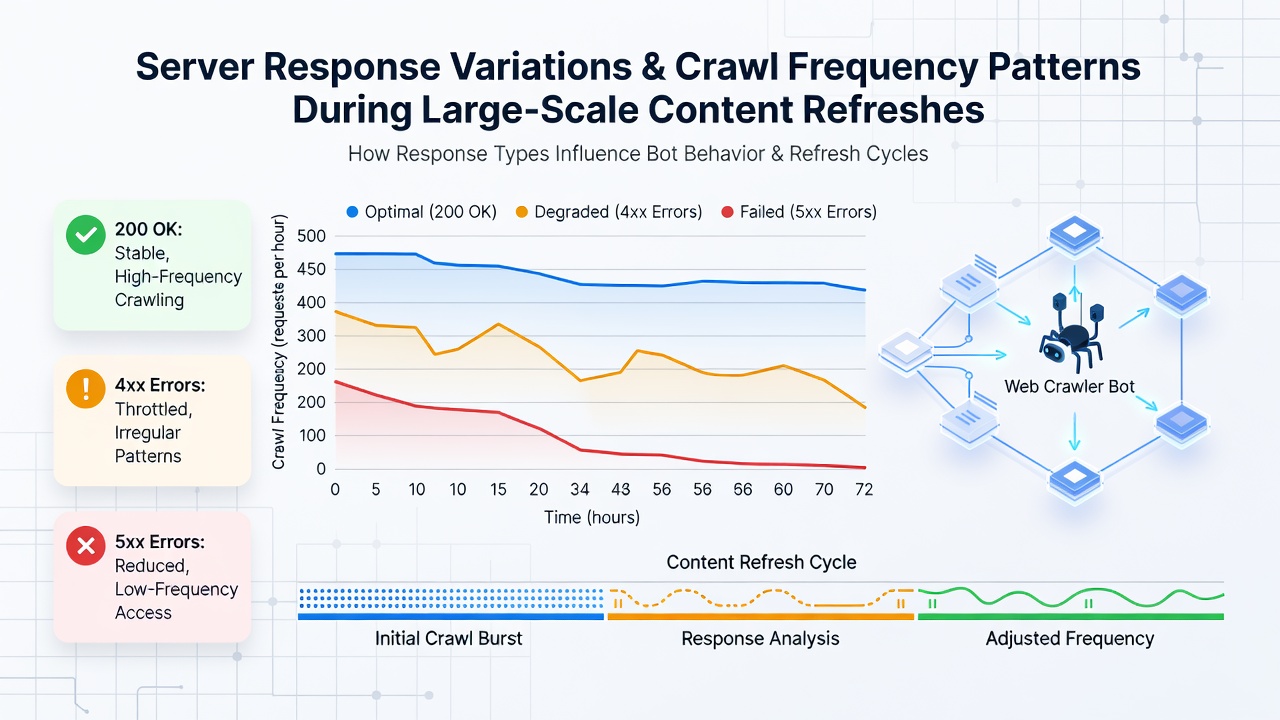
HTTP status codes operate as primary triggers for crawl scheduling adjustments because crawlers log every response type and feed those logs into frequency algorithms. A consistent stream of 200 OK responses paired with stable response times encourages repeated visits, whereas clusters of 5xx errors prompt temporary reductions in crawl rate to avoid overloading servers that appear unstable. Redirect chains, especially those exceeding two hops, create additional processing overhead that some crawlers factor into future scheduling decisions, leading to slower revisits until the chains shorten.
Response latency adds another layer because bots measure time-to-first-byte and total download duration on each request. Sites that deliver content under 300 milliseconds during refresh periods typically maintain or increase their crawl allocation, while spikes above one second correlate with reduced frequency in subsequent days. Data collected across multiple enterprise migrations shows that servers returning compressed responses with proper cache-control headers experience steadier crawl patterns than those delivering uncompressed payloads without explicit expiration directives.
Patterns Observed in Large-Scale Refreshes
When content teams simultaneously update tens of thousands of pages, the resulting server load often produces temporary response variations that reshape crawl behavior for weeks. One documented case involved a retail platform that refreshed product descriptions across 80,000 URLs in a single weekend; the accompanying increase in 503 Service Unavailable responses led to a 40 percent drop in daily crawl requests for the following 11 days until error rates normalized. Observers note that crawlers appear to treat such spikes as capacity warnings and throttle activity accordingly until monitoring systems detect sustained improvement.
Another pattern emerges around conditional responses using If-Modified-Since headers. Sites that correctly implement 304 Not Modified replies during refresh cycles conserve crawl budget because bots receive confirmation that unchanged sections require no further processing. In September 2026, several large publishing networks reported that enabling proper 304 handling across refreshed archives restored pre-refresh crawl rates within four days, whereas sites relying solely on full 200 responses continued to see depressed frequency for nearly two weeks.
Interaction With Crawl Budget Allocation
Crawl budget represents teh total number of requests a bot will make to a domain within a given timeframe, and response variations directly modulate that limit. According to specifications maintained by the Internet Engineering Task Force, consistent server behavior allows more accurate prediction of resource availability, which supports higher allocation. When servers deliver mixed signals through fluctuating status codes or unpredictable latency, allocation algorithms reduce the budget to prevent inefficient resource consumption on the crawler side.
Studies from academic institutions such as those documented in proceedings from the University of Waterloo highlight that error rate thresholds around five percent trigger measurable frequency reductions across multiple bot types. During refreshes, maintaining error rates below two percent while keeping average response times under 500 milliseconds has been associated with stable or increased crawl volumes in the weeks following deployment. Sites that fail to monitor these metrics often experience prolonged recovery periods because the reduced crawl rate delays discovery of the newly refreshed content itself.
Header Configurations and Secondary Effects
Beyond status codes and timing, response headers such as Retry-After, X-Robots-Tag, and varying Cache-Control directives further shape future visit patterns. A server that includes a Retry-After value of 3600 seconds after encountering load spikes effectively signals a one-hour cooldown, and crawlers generally respect that window before attempting new requests. In contrast, the absence of such headers during high-error periods can lead to repeated immediate retries that further strain resources and extend the period of reduced frequency.
Content refreshes that involve URL restructuring also interact with response variations because 301 and 302 redirects must resolve cleanly for crawlers to transfer existing crawl equity to new locations. Multiple redirects or redirects that ultimately return error responses create compounding delays that slow the overall refresh propagation across search indexes.
Conclusion
Server response variations function as continuous feedback mechanisms that recalibrate crawler behavior throughout large-scale content operations. Organizations that maintain low error rates, consistent latency, and proper header implementations during refreshes typically preserve crawl frequency, allowing new content to be discovered and indexed without extended delays. Monitoring tools that track response distributions in real time provide the visibility needed to address issues before they produce lasting reductions in crawl allocation.